Description
Verified for High-Speed Printing
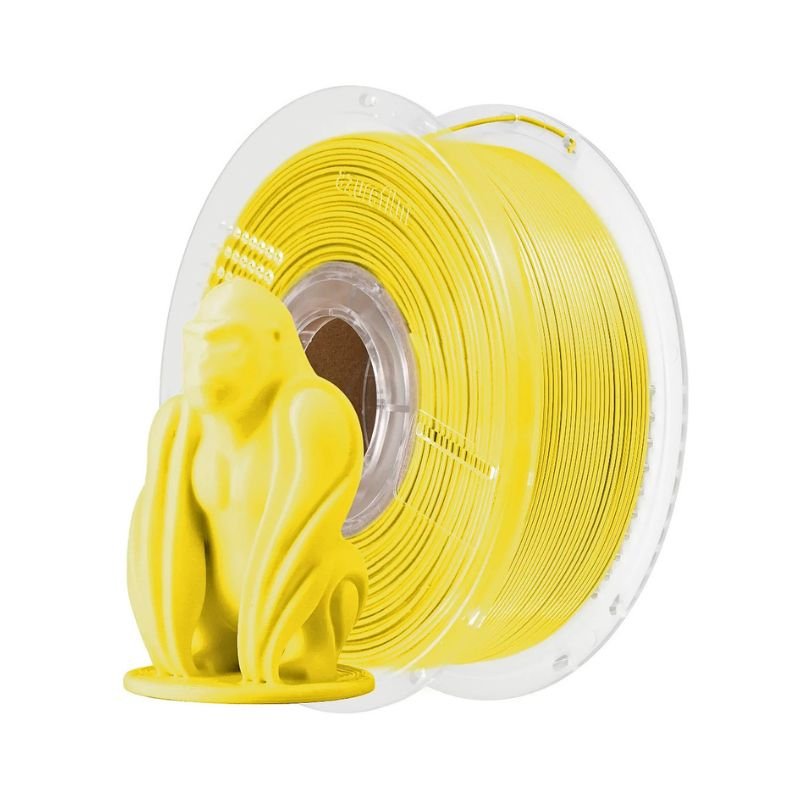
PETG Filament Cyprus — AzureFilm PETG HS Yellow
If you’re searching for PETG filament in Cyprus that can handle a fast printer, AzureFilm PETG HS gives you the same reliable PETG formula you already trust, now tested and tuned specifically for high-speed printing.
So instead of choosing between speed and quality, you get prints that finish faster while still holding their strength and finish.
Verified High-Speed Performance
Since it’s tested on real high-speed printers, you can push print speed further with confidence.
Strength Without Compromise
Even near your printer’s speed limits, it keeps the mechanical strength PETG is known for.
Temperature Resistant
It withstands temperatures up to 80°C, so prints hold their shape in warmer conditions.
Food-Safe
Because it meets EU requirements for food contact materials, it also suits kitchen-adjacent prints.
Same Formula. Verified for Speed.
Why AzureFilm Built PETG HS
AzureFilm’s original PETG formula was always capable of printing faster than most people realised — it just hadn’t been fully tested or communicated. So the company ran a series of controlled tests, gradually pushing print speed and monitoring extrusion flow and print quality at each stage.
Because true high-speed performance depends on volumetric flow rate (how much filament can be melted and extruded per second) rather than just linear speed in mm/s, that’s what AzureFilm measured directly, rather than only quoting a top speed number.
Tested on Popular High-Speed Printers
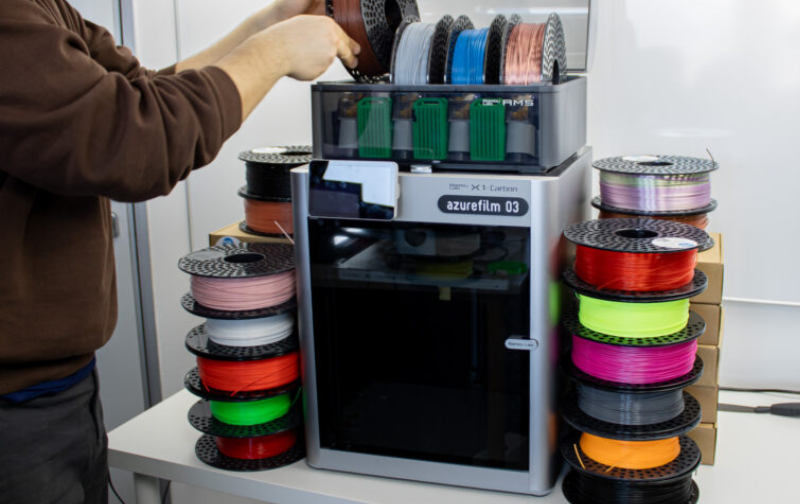
AzureFilm tested PETG HS across several fast consumer printers, so you can get a sense of how it performs on hardware similar to yours.
| Printer | Result |
|---|---|
| FLSUN T1 Pro | Reached roughly 85 mm³/s of the printer’s 90 mm³/s maximum flow rate, sustaining speeds up to 1000 mm/s at standard layer settings without stringing or under-extrusion |
| Bambu Lab X1 Carbon | Achieved around 20 mm³/s flow (close to the printer’s user-tested 23 mm³/s ceiling), well above the roughly 12 mm³/s that default PETG profiles typically allow |
| Prusa MK4 | Also reached around 20 mm³/s with tuned settings, again well past the default 12 mm³/s limit, while keeping print integrity intact |
Since these figures depend on your specific printer, nozzle, and slicer settings, treat them as a benchmark rather than a guarantee — but they do show this filament thrives well past what a default PETG profile assumes.
Getting the Best Balance of Speed and Quality
- Keep outer and inner wall speeds at default settings for the best surface finish
- Push infill speed higher, since visual quality matters less there than on visible surfaces
- Stay within your printer manufacturer’s speed and flow limits for long-term reliability
Because some high-speed filaments trade mechanical strength for raw speed, it’s worth noting that PETG HS keeps its structural properties even when you’re operating near your printer’s upper limits.
Printing Recommendations
| Setting | Recommendation |
|---|---|
| Nozzle Temperature | 220–240°C |
| Bed Temperature | 80°C |
| Build Surface | Glass bed, PEI sheet, Kapton, or blue tape with 3Dlac spray |
Since ideal temperatures can vary between printers, treat these as a starting point rather than a fixed rule.
AzureFilm PETG HS Features and Properties
| Property | Rating |
|---|---|
| Flexibility | Medium |
| Strength | High |
| Durability | High |
| Difficulty to Use | Low |
| Shrinkage / Warping | Minimal |
| Soluble | No |
| Diameter Available | 1.75mm |
| Manufacturer | AzureFilm |
PETG Filament Cyprus — Delivered Island-Wide
AzureFilm PETG HS Yellow is available from The 3D Factory, so wherever you are in Cyprus — Nicosia, Limassol, Larnaca, Paphos or Famagusta — we can deliver it to you.
If you’re printing on a Bambu Lab machine, this filament also works well beyond the default Bambu PETG profile limits — worth pairing with our Bambu Lab printers and AMS systems.
Related Products and Resources
PETG Filament Cyprus — HS FAQ
What makes PETG HS different from regular PETG?
It’s the same trusted PETG formula, but AzureFilm has tested and verified it specifically for high-speed printing, so you can push your printer harder with more confidence.
How fast can I print with PETG HS?
That depends on your printer. On a fast machine like the FLSUN T1 Pro it reached close to the printer’s own maximum flow rate, while on machines like the Bambu Lab X1 Carbon or Prusa MK4, it comfortably exceeded their default PETG profile limits.
Does printing faster reduce print quality?
Not within tested limits. Because PETG HS keeps its strength even near a printer’s upper speed range, quality holds up well as long as you stay within your printer’s manufacturer-defined limits.
Will it work on my printer if it’s not one of the tested models?
Yes. Since PETG HS is still a standard 1.75mm PETG filament, it works on any compatible FDM printer — you’ll simply get the biggest speed benefit on printers with higher flow-rate capacity.
What temperature should I print PETG HS at?
We recommend 220–240°C at the nozzle with an 80°C heated bed, though this can vary slightly depending on your printer.
Is PETG HS food-safe?
Yes, it meets EU requirements for materials in contact with food, so it suits food-adjacent prints as well as general use.
Is high-speed PETG filament available in Cyprus?
Yes, The 3D Factory stocks AzureFilm PETG HS and delivers across Cyprus.